Supply duct source removal addresses the positive-pressure side of forced-air heating and cooling systems. While return ducts collect room air, supply ducts channel conditioned air directly into bedrooms and common…
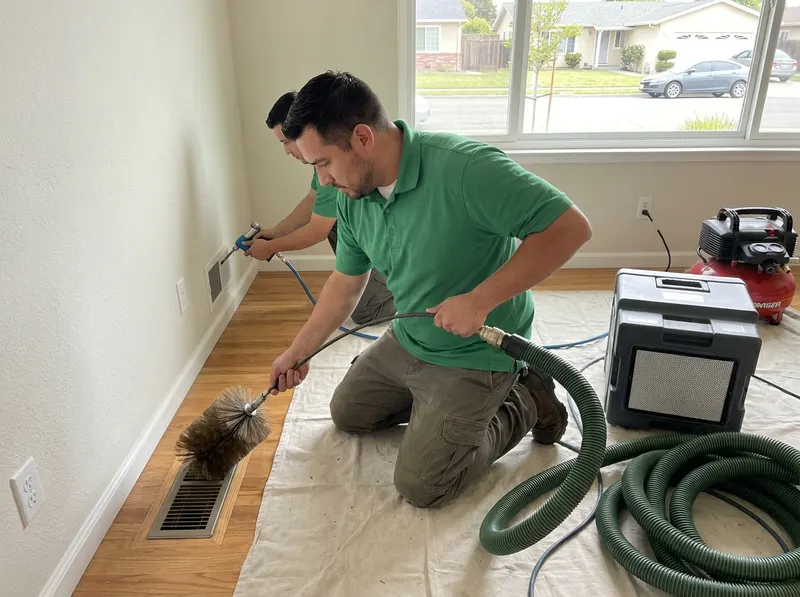
Supply duct source removal addresses the positive-pressure side of forced-air heating and cooling systems. While return ducts collect room air, supply ducts channel conditioned air directly into bedrooms and common spaces. When particulate gathers inside supply boots and internal line walls, every fan cycle pushes fine debris into the living environment, often causing visible dust rings around ceiling diffusers and triggering night-time respiratory irritation. In older residences throughout Willow Glen and Cambrian Park, vintage sheet-metal branch runs accumulate decades of particulate, whereas newer builds in Silver Creek and Berryessa frequently contain gypsum dust left behind during wallboard installation. This procedure relies on the NADCA ACR standard of mechanical agitation paired with HEPA-filtered vacuum extraction running at 2,500 to 4,000 cubic feet per minute, capturing contaminants under sustained negative draw so dust cannot enter living areas.
Selecting true source removal differs fundamentally from superficial vent sanitizing or chemical fogging sprays. Fogging introduces liquid biocides into dusty ducts without lifting the settled debris layer, creating a tacky surface that catches secondary dust. If a home has suffered post-renovation dust surges or fine wildfire particulate from regional smoke seasons, mechanical source removal is required to strip physical matter from duct surfaces. When supply branches consist of flexible ductwork, common in Blossom Valley, Almaden Valley, and West San Jose track developments, rotary nylon wands replace rigid steel whips to protect inner polymer liners from punctures. Rigid sheet-metal ductwork found in historic Naglee Park and Rose Garden homes accepts high-velocity reverse-air sweepers that move heavier particulate down trunk lines toward the vacuum collar.
Execution follows an objective, sequential standard. Technicians map every branch run, seal off non-targeted vents to concentrate negative air velocity, and insert specialized pneumatic or motorized heads through each register opening. A multi-point visual inspection before agitation documents the particulate density inside the supply plenum and boots, preventing unverified claims. Because accessing second-story branches in two-story properties requires specific trunk taps, the configuration avoids cutting dry interior drywall. The minimum charge for localized supply source extraction is $200, with total costs governed by the number of supply vents, system layout, and line condition determined during the on-site physical evaluation.
Every job gets a firm, written price after a free on-site visit.
Tell us about your supply duct source removal job in San Jose and we'll send a clear, written quote, usually the same day.
 EverGreen Ridge HVAC